
Cape Coral Is About to Grow Again, with a $221 Million Price Tag Attached. |
A visionary development bringing 2,500 new homes and a master planned community vision to Cape Coral, FL |
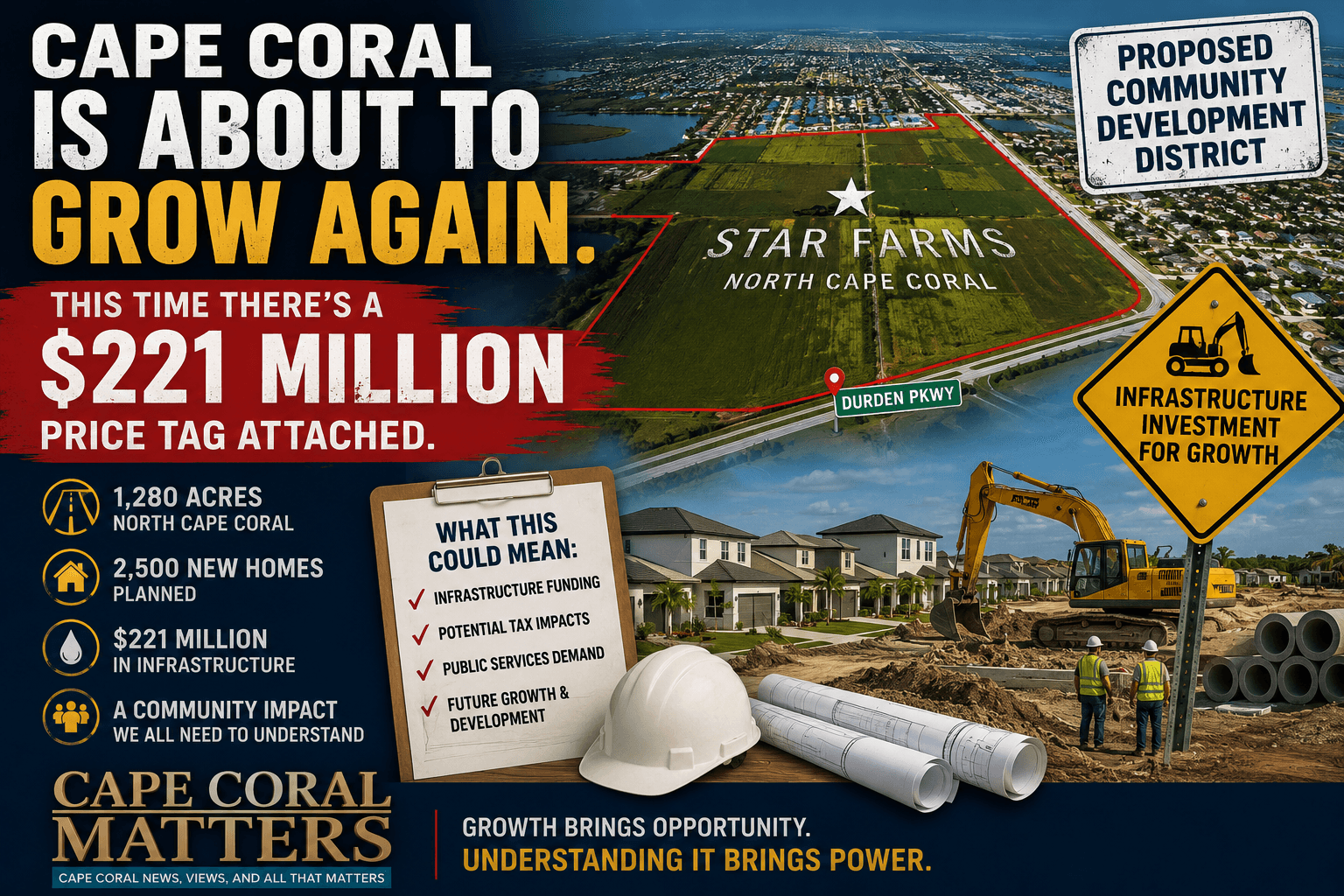
Nearly 1,280 acres. About 2,500 homes. And a new special district that could put the cost of massive infrastructure improvements onto the properties being developed.
Cape Coral has never exactly been shy about growth. But what is taking shape in the northern part of the city isn't another 50-home subdivision tucked behind a new entrance sign. This one is measured in thousands of homes — and hundreds of millions of dollars.
The Cape Coral City Council has approved the creation of the Star Farms at Cape Coral Community Development District, covering approximately 1,279.549 acres in north Cape Coral. The property sits east of Burnt Store Road, south of Yucca Pens Preserve, north of Wilmington Parkway and west of Andalusia Boulevard. The City's official July 22 meeting summary confirms that Council approved Ordinance 35-26 establishing the Star Farms CDD. The district's official website also confirms its boundaries and acreage.
Here's a number that should get your attention: $220,985,639.90.
That's the preliminary estimated cost — including a 15% contingency — of infrastructure associated with a master-planned development currently expected to contain approximately 2,500 residential units, according to the official petition to establish the district. Or, rounded off for those of us who don't carry calculators: About $221 million. Which brings us to the obvious question:
Who's writing the $221 million check?
The answer is where this story gets interesting. Meet the Three Letters Future Buyers Should Know: CDD. A Community Development District, or CDD, is a special-purpose governmental entity authorized under Chapter 190 of the Florida Statutes. CDDs can be used to plan, finance, construct, operate and maintain infrastructure serving a defined development. Instead of requiring a developer to necessarily fund every piece of infrastructure upfront, a district can issue bonds to pay for qualifying improvements.
Those bonds can then be repaid through non-ad valorem special assessments imposed on property within the district. Those assessments can appear on a homeowner's property-tax bill, but they are separate from the traditional property tax calculated from the home's taxable value. In plain English, Buy a property inside the district, and you could also be buying a share of the bill for building the infrastructure serving it.
Does This Mean Current Cape Coral Homeowners Are Paying $221 Million? No — and that's an important distinction.
The Star Farms petition specifically presents the CDD structure as a way to provide infrastructure without imposing the development's financing burden on Cape Coral's general population. The City's own July 22 Council meeting highlights describe a CDD as a mechanism allowing a private development to pay for its own infrastructure and amenities. Any debt issued by the CDD would be an obligation of the district, not general debt of the City of Cape Coral.
No one knows how much a Star Farms homeowner's assessment would be, when it would begin, or how long a particular assessment would remain attached to a property. Florida law does, however, require CDDs to disclose information concerning public financing and maintenance of improvements to existing and prospective residents. You can read that requirement in Florida Statute 190.009.
Who Owns Everything After It's Built? Here's another wrinkle.
Just because the CDD finances infrastructure doesn't necessarily mean the CDD keeps all of it. According to the project documents, the district is expected to own and maintain items including drainage systems, environmental restoration or enhancement, perimeter landscaping and walls. The City and other governmental entities are expected to ultimately own or maintain certain accepted infrastructure, including sanitary sewer, potable water and some roadway improvements depending on jurisdiction. That means the CDD can finance infrastructure that may eventually become public infrastructure.
Again, that's not some exotic Cape Coral invention. It is part of the framework Florida created under the Uniform Community Development District Act. But when the number approaches a quarter-billion dollars, it's worth understanding exactly what's happening.
Burnt Store Road and the enormous stretches of undeveloped land surrounding it aren't simply Cape Coral's outskirts anymore. They're becoming Cape Coral's next frontier. Cape Coral isn't finished growing. Not even close.
But the mechanism for paying for what's underneath them is already being put in place. Official Resources |

32 Comments
Join the conversation
I looked at the Star Farms CDD website linked in the article and there is not much there yet. For a project this size it would be nice to see more public information available. Transparency matters when you are talking about $221 million.
Steve MoralesThat's pretty common for CDDs in early stages honestly. The site usually fills in once bonds are issued and the district board starts holding public meetings. Worth checking back in a few months.
Can someone tell me if the Yucca Pens Preserve is fully protected here or if any of that land is at risk? The article says the development is south of it but I want to make sure there is a real buffer and not just a line on a map.
Florida has hundreds of CDDs and most of them function without drama. People act like this is some scheme but it is just a financing tool. The real question is whether the development itself is planned well, not whether the CDD exists.
I keep seeing people say existing taxpayers are protected but every time we grow the city, something ends up getting spread across everyone. Fire stations, dispatch, code enforcement. None of that is free.
yvonne_cc_nativeYou're not wrong. The CDD handles the pipes and drainage but the moment those 2,500 homes are full you've got thousands more people calling 911, needing code enforcement, using the library. That overhead lands on the whole city eventually.
Wilmington Parkway as a southern boundary. That road floods when we get a heavy storm. Curious how the drainage infrastructure in this plan accounts for that because 1,280 acres of new impervious surface is going to push water somewhere.
Frank D.This is a really important question. The drainage section of the petition should address it but I'd want to see what the engineers are actually proposing for water retention on that footprint. That's a lot of runoff headed somewhere.
The 15% contingency added on top of the base cost is smart planning but also tells you everyone knows these things run over budget. That contingency could disappear fast on a project this size.
Melissa CraneGood point. On a project budgeted at $221 million that 15% contingency is already over $28 million. One bad materials cycle or permitting delay and that cushion is gone pretty quickly.
I grew up near Burnt Store Road when there was nothing out there but scrub and the occasional gopher tortoise. Feels strange to see all of this coming. Not saying bad, just feels like the end of something.
Andalusia Boulevard barely handles current traffic and that is one of the boundary roads for this whole thing. Someone better have a serious traffic study in hand before a single permit gets pulled.
Denise OchoaCompletely agree. I drive Andalusia a few times a week and it already backs up near the intersections we have now. Adding thousands of homes to that area without serious road improvements first would be a real problem.
The CDD structure makes total sense for a project this size. Developer gets the infrastructure built, buyers pay over time, existing taxpayers are not on the hook. I know people are nervous but this is literally how Florida designed it to work.
Ben RussoI hear you and the structure itself is fine in theory. My concern is always whether buyers actually understand what they're agreeing to at closing. The design being sound doesn't mean every buyer reads the fine print.
My concern is schools. 2,500 homes means thousands of kids and Lee County schools are already stretched thin. Is there any plan being discussed for that or are we just building houses and hoping for the best.
1,279 acres is not a neighborhood, that is basically a small city. And we are just sliding it into north Cape Coral like it is a routine rezoning. Wild.
Who approved this and what was the vote count? Would love to know if any council members pushed back or if this sailed through without much debate.
gulfcoast_galThe article says it was approved July 22 under Ordinance 35-26. Doesn't give a vote count though. That would be worth looking up in the actual meeting minutes on the city site.
Good breakdown of what a CDD actually is. Most people in this town have no idea how these districts work and then they wonder why their tax bill looks weird. Appreciate the explanation.
Carlos FuentesSame thing happened to us when we bought. Saw the CDD line on the closing docs and had no clue what it meant until we got our first tax bill. Glad articles like this exist now so people can actually look it up beforehand.
Cape Coral has been saying it is not done growing for 30 years and every single time it is true. At some point I guess we just accept it and hope the planning catches up to the pace.
Lori B.Ha, fair point. I moved here 12 years ago and people were already saying the same thing then. At this point I just hope the roads and schools actually keep pace this time around.
The part about the CDD financing infrastructure that eventually becomes public property is worth paying attention to. So the new homeowners pay to build it and then the city takes it over. I am not saying that is wrong, I just think it deserves more conversation.
Dave KrentzThat part stood out to me too. New residents finance the build and then the city absorbs the asset. I get why it works that way operationally but it does feel like an interesting arrangement worth spelling out clearly in any sales disclosure.
My neighbor just bought in a CDD over in Lee County and her assessment alone adds almost $2,000 a year to her bill. That is on top of regular taxes. Just want people to know what they might be getting into.
$220,985,639.90. Someone sat there and typed out those extra 90 cents. The precision is kind of hilarious but also, that is a massive number and I want to know what happens if the bonds don't get repaid.
Finally some development up in north Cape. That whole stretch near Yucca Pens has just been a big nothing for as long as I can remember. Bring it on honestly.
Joanna T.I know what you mean, I drive that stretch all the time and it really has just sat there. My only hope is they sort out the road situation before it gets built out because Burnt Store can get brutal during season already.
People need to actually read what a CDD assessment means before they sign a purchase contract. I bought in a CDD community years ago and the line item on my tax bill was a real surprise. Not saying it's bad, just saying buyers need to go in with eyes open.
Rick DelgadoThis is exactly right. A friend of mine bought in Babcock Ranch without fully understanding the CDD assessment and it added a meaningful chunk to her annual costs. Not a dealbreaker but definitely something you want to budget for upfront.
I live right off Burnt Store Road and have been watching that land sit empty for years. Now 2,500 homes and a quarter billion dollars worth of infrastructure? My commute is already rough. Those roads are not going to handle that kind of growth no matter what the CDD pays for.